Showing posts with label Internet. Show all posts

Sunday, 5 August 2012

When a newspaper joke gets lost online

Every newspaper worth its salt has an online presence. Which is fantastic. And probably obligatory. But a print media company is doing more harm than good to itself if its system automatically uploads print articles to the internet.

Because print simply doesn't translate well online.

The art to page layout - using large headline fonts and pictures, and top to bottom positioning to denote news prioritisation - is lost when even the tiny 8-inch long story buried in the bottom left corner of the page gets its own web address.

And missing context can ruin what the paper stands for.

Take the example of this unfortunate article on The Hindu.  It appeared, presumably as a small column with a thumbnail in the lifestyle supplement of the paper, part of a regular 'how to' section, which is usually formatted to indicate that it's a light-hearted, tongue-in-cheek, humorous column.

While the humour in this piece is admittedly questionable for any medium, the point is completely lost on online visitors, who see an absurd, grammatically incorrect headline ("...get any girl to go out with you") amidst stories of drought and politicking.

Isn't that shooting yourself in the foot when the whole point of your recent marketing campaign was about how The Hindu "stays ahead of the times" without dumbing down news?

Being part of the team that's put in a lot of work into the print edition, it's a real pity to see the message lost in translation.

Thursday, 16 June 2011

Stop the Presses!

I spend my evenings - six days a week - at work at a newspaper, labouring lovingly over news copy that, I am acutely aware, will only be served cold with someone's morning coffee.  

Considerable time and effort goes into making a newspaper. A bunch of reporters, photographers, sub editors and editors are working odd and/or long hours, following a tradition of news gathering and dissemination fine-tuned over decades, as a regal masthead never fails to point out.

All that work for nothing.

The said masthead has only borne witness to a news cycle that only gets shorter. And Thursday's story with Wednesday's data that I painstakingly corrected and placed in prime position on what will be Friday's newspaper, just so you can read it on Friday evening after work, is then just a jaded retelling of something you already saw on the tele or your RSS feed.

So, it is exceedingly heartening - I thanked the lord and everything - that a major newspaper breaks this floundering tradition with a clarification of what a print-based news organisation can do to turn its fortunes around.

When The Guardian gets ready to "double digital revenues" and "spend 80% of its focus on digital", I am hopeful that it is an example of how newspapers can break the "breaking news" cycle to put the emphasis back on good journalism, without the "deadline" excuse for shoddy reporting. Or for rehashed press releases.

From editor-in-chief Alan Rusbridger:
Every newspaper is on a journey into some kind of digital future. That doesn't mean getting out of print, but it does require a greater focus of attention, imagination and resource on the various forms that digital future is likely to take.
The article continues:
Based on research that showed that half of readers read the newspaper in the evening, the aim was to create a title that would be "as relevant at 9am as 9pm". It would focus less on breaking news and instead aim to emulate "Newsnight not News at Ten".
Seems obvious for any newspaper, no?

Nothing tells a story like words and pictures. Whether on 20 sheets of paper delivered at your doorstep or via scrollable text at the click of a mouse. Surely it is common sense for print to converge with online/ digital journalism?

Wednesday, 27 April 2011

Privacy 1, Rubbish news 0

An oft repeated statement about social networking sites is that putting up any personal information online is an automatic renunciation of privacy.

"If you have something that you don't want anyone to know, maybe you shouldn't be doing it in the first place," former Google CEO Eric Schmidt famously said.

However, using the many benefits of sites that encourage sharing personal information does not automatically translate into non-existent expectations of privacy.

So, I'm glad that there's been a recent ruling that's a definite shot in the arm for privacy in India, especially given recent possible erosions of the same.

Details of the case against TV9 Hyderabad brought in front of the News Broadcasting Standards Authority of India have been explained in detail at that link. To summarise, TV9 accessed the photographs and personal details of members of a networking site for gay men and splashed the same all over the tele in their hour-long report about "rampant gay culture" in Hyderabad, claiming that the information was easily accessible and in the public domain.

The absolutely juicy part of the ruling against their argument:
“While the names, particulars and photographs etc of individuals may be available in the.. members-only section, it cannot be said that such names, particulars and photographs are therefore available in the public domain”

As paraphrased:
Justice Verma seems to be saying, merely because one volunteers to publish information about oneself on a social networking site, one has not thereby foregone all of one’s rights to privacy against the world. Social networking sites are thereby construed as private spaces and decidedly not “public” ones.

Friday, 26 November 2010

Witty, pithy criticism at the click of a mouse - 1

twitterjoke

On November 11, Paul Chambers, an accountant from UK, lost an appeal against a conviction and £1000 fine for a flippant comment made on Twitter that the judge thought was a “menace” and a realistic threat.

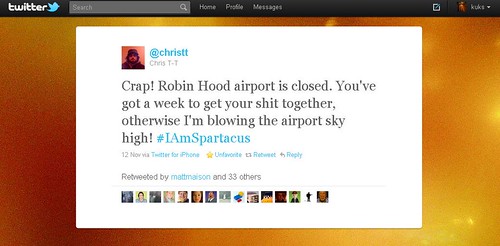
Taking up against what is definitely a dangerous legal precedent in the exercising of the freedom of speech and expression – heck, even humour or ill-tempered grumbling – online, thousands of Internet users, responded to the “#twitterjoketrial” with, what else, but more flippancy and wit.

A tweet (pictured above) by @christt, one of the many who thought the official decision was more than a little ridiculous, started a tongue-in-cheek movement that was a comment against the state of affairs. Then,
Under the hashtag #IAmSpartacus – a reference to the film in which Spartacus's fellow gladiators show their solidarity with him by each proclaiming "I am Spartacus" – thousands of people have copied Chambers's original message. (The Guardian)  
via Mashable

Everyone who was using the hashtag was courting censure by the authorities, but in their shared indignation, the Internet community was also actively fashioning witty social commentary.

#IAmSpartacus became the latest story of satire on the Internet.

 (There's more coming, when I get around to writing it, which will be later tonight!) 

Tuesday, 30 June 2009

Goodbye to The Pirate Bay?


The world's largest bit torrent tracker and the symbol of Internet anarchy is going corporate.


The Pirate Bay has confirmed the news it is being acquired by Swedish software company Global Gaming Factory X AB for the equivalent of $7.8 million.

TPB crew claim that this is in the best interest of innovation, an ideal they've always claimed to stand for.

"If the new owners will screw around with the site, nobody will keep using it. That's the biggest insurance one can have that the site will be run in the way that we all want to," says the blog post announcing the decision. "It's win-win-win."

If they seemed naive in fighting for open culture, in court, against the clout of the big media houses, this seems more so.

GGF, in its release, doesn't take long to clarify its intentions: "GGF intends to launch new business models that allow compensation to the content providers and copyright owners."

That sounds like the death knell for the steadfast and irreverent pirate stand on the many legal threats they receive, never to take down anything from their site.

Whatever GGF's plan is, it surely isn't the end of file sharing, and TPB founders know this better than anyone.

However, it could well be a blow to the Pirate ideology and everything TPB stood for in the fight for a free Internet. It's been a huge influence in deciding our online culture. 'Sell-out' is a word that's appearing rather frequently in the comments that have greeting TPB's announcement, with the bit torrent loyal threatening to delete their accounts.

The announcement comes at a time when the founders face a huge lawsuit and there are questions still being asked if the judges in the the Pirate Bay trial were biased.

Wednesday, 27 May 2009

It's a pirate's life for me

I finished re- reading Free Culture by (well,) free culture cheerleader Lawrence Lessig.*

Just in time to hear old arguments from the entertainment industry all over again. This time, it's Sony Pictures Entertainment CEO Michael Lynton dissing the internet for ruining the industry.

This post is not arguing what he says. That's what TechDirt did brilliantly.

I'm just here to take exception to this:
And my point is this: the major content businesses of the world and the most talented creators of that content -- music, newspapers, movies and books -- have all been seriously harmed by the Internet.
'Most' talented creators? Who, the ones at Sony? The ones who last made Angels & Demons which was, if I'm being complimentary, average at best?

The ones signed on by the big names are not always the most talented, just that they sell better.

Talent's very much on display elsewhere online and it doesn't need to have a million dollar marketing price tag on it.


*Yes, I did download a free online copy to sample before I picked up the printed version. See, I just proved his point.
 
Creative Commons License
This work is licenced under a Creative Commons Licence.